Saturday, April 25, 2026

Fun Bugs - Chicken Bread!

 As I was finishing up the demo launch build of Witherspring Wilds to share with playtesters and doing some last minute tests, I came across something very bizarre. When I completed the Planting Tomatoes quest, Riley gave me Chicken Bread!

And, from that point on, until I restarted the game, all bread was referred to as Chicken Bread in dialogue (but not, unfortunately, in my inventory, where it was just plain old boring bread). Mind you, there is no such thing as Chicken Bread in the game, and I've never added an item like that!

So, what was going on here? I knew one thing - many food items, including bread, allow mix-ins - for example, you could add acorns to your bread dough to make Acorn Bread, or apples to your cake to make Apple Cake. However, there is no actual way to make Chicken Bread, as the recipe for bread only allows nuts or seeds, and the bread she gave me was normal, everyday bread, with no chicken mix-in. To add to the headache, when I reloaded the game and tried this again to track down the issue, it was back to normal!

It turns out the culprit was Chester, another NPC:

If you talk to Chester before Riley, he mentions Chicken Soup, which is a mix-in food item. But, he doesn't actually reference a specific item, instead it is a temporary item that is used for pretty much all dialogue. And it sets the mix-in to chicken to make it Chicken Soup for this dialogue. But, it never clears that mix-in, so any food mentioned afterwards that can have a mix-in, but doesn't have a mix-in set, will be Chicken!

The fix was simple - I just had to reset the temporary item after each reference. But it still remains a funny and surprising bug that was worth sharing. And ever since telling him about the bug, my 8-year old son won't stop singing about Chicken Bread!

Anyways, just wanted to share this fun tidbit as we finish up everything for the Witherspring Wilds demo launch! I'm excited that we will be sharing this game with the world in just a matter of days now! Keep an eye out for updates on our Discord!

Thursday, February 19, 2026

Introducing Witherspring Wilds

There's always something refreshing about starting a new game project. There are endless possibilities and pure creative freedom. Designing new worlds and systems without constraints and seeing it come together into something new always brings me joy. And this time, I designed something quite massive, you could even call it a dream game (I certainly had many ideas for it in my dreams). While there's always a risk making something huge, there's also something special - as it gives that same sense of limitlessness that I enjoy so much about game development.

Witherspring Wilds is meant to be a truly open world game - with a very large realm to explore, taking place over many in game years, and eventually seeing multiple family generations. There's combat, mining, crafting, building, farming, spells (both combat and utility) - even creature taming. There are NPCs to befriend and romance, and they have their own goals, skills and stories. You can even hire NPCs to work for you - watering crops, building houses, etc - letting you choose what you want to specialize in, and what you'd prefer the NPCs to advance (or become a jack of all trades and do it all yourself).

The various systems overlap in many ways, and there have been lots of "Aha!" moments even for me, like when I realized that scarecrows (meant for farmers to keep Afowl away from their crops) could be used to set up movable safe zones you could snipe Afowls from within. My hope is that even beyond the story and questline I'm adding to the game, players will be able to create their own stories and emergent gameplay.

Unlike other life sims, in Witherspring Wilds, you enter a new world full of nature along with a handful of other NPCs. There is no village to start - you have to build it alongside the NPCs. As the months and years progress, the village will expand and become more modern, and you will have been a part of shaping it from the very beginning. There are very few limitations on what you can build, or where you can build it - the world is yours to shape and explore.

I have a lot of ideas for what you can unlock in game across the generations - both in terms of technology and magic. I think it will be really special to see the world and characters evolve over time. Taming is also really exciting - you're never required to tame animals, but all natural animals in the world are tamable and have many different uses as pets - from riding Goxen, to having a Cattern defend you from enemies.

There's a whole lot more I could tell you about this game, as there's a whole lot TO this game, but I think I'll end this blog post here for now! I hope you're intrigued by what you see, and maybe even excited - I'm certainly excited! It's definitely a big undertaking (and perhaps not the wisest business choice), but perhaps not worrying about the state of the industry and just making what I'm passionate about is the best idea - it's something only an indie dev like me could attempt!

If you're interested in learning more, join us on Discord or wishlist Witherspring Wilds on Steam!

Tuesday, May 13, 2025

Dealing with Failure

 After the end of Aground, I had a ton of ideas and the potential to make anything. It was a time of excitement, when Fancy Fish Game's future seemed bright, and so I decided to make two games at the same time - you can read about that here: https://david.fancyfishgames.com/2022/09/two-games-at-same-time-crazy-or-genius.html

After entering Early Access, it became clear that Stardander would never be a commercial success. And while we still plan to finish Stardander (in fact, Chapter 5 is coming out soon), it took a back seat to Aground Zero which seemed much more promising.

The Early Access launch of Aground Zero was actually very strong in terms of sales and interest. While there were some who didn't like that the game was 3D, overall the reception was positive and what people wanted most was more. So, I expanded my original idea for the game (the initial design document ended after building the com station, without interstellar travel or the magic path), and tried to live up to those expectations.

My hope was that the work would be appreciated, and that the full launch would be bigger than the Early Access launch, which was my experience with Aground (and this is when Steam gives you your launch visibility round, so that's why the full launch is usually big). But, as time went on, interest in Aground Zero waned. Despite plenty of updates - adding more features than I expected to like online multiplayer, multiple endings, spaceships, dragon riding, new planets and quests etc, I could tell something was wrong.

Long story short, the full launch was abysmal - worse than Aground Zero's Early Access launch. I'll be lucky to break even on expenses, let alone have anything left over to pay myself for the four years of work I put into Aground Zero. In short, I made two games, hoping for both to succeed but expecting at least one to do well, and both games flopped.


The reviews since we left Early Access are also poor. Players feel like the game is too short, and doesn't have enough content - with most of them even admitting the game was fun for the first few hours. This really hurts - I worked hard and made a game that has hours of fun, but the reviews are mostly negative because they were expecting a lot more. To fulfill the expectations of these reviewers, I would probably have to spend another four years and end up further in the red - in short, it's not feasible. I never expected Aground Zero to be a huge game, but an interesting spinoff in 3D. But that wasn't the expectation players had, and they ultimately felt let down by the game, not appreciating it for what it was.

Honestly, I feel like a 10 hour game for $20 is very reasonable, but players simply don't agree - and they have reason not to. There are games out there that have more content for less money, and that's just the way the industry is. There's definitely been a shift lately, and it's become much harder to find success now compared to when Aground launched in 2020. Partially this is due to a temporary surge of players during the pandemic, which made sales of games around 2020 stronger but also caused a lot of new game developers and games to pop up hoping to ride that wave. Now that the surge is over, there is more games than demand for them, and many studios are going under. There could also be changes to the Steam algorithm which no longer favor smaller indie games - this is just speculation, but they've changed the algorithm many times during Aground's lifetime, often with noticeable spikes and lulls of sales.


So what does this mean for Fancy Fish Games? Having both games flop is a huge blow to the company and very depressing personally, but we are in a fortunate circumstance where the success of Aground (original) can keep us afloat a little longer. I've already started our next game - which you can see hinted in our year in review post: https://david.fancyfishgames.com/2024/11/year-in-review-2024.html , and I plan to continue working on it - taking what I've learned from Aground Zero and adding more content in a simpler pixel art style. I'll have to be more cautious, perhaps doing another Kickstarter before charging ahead with the new game, but I do think it's a great idea. But if this new game struggles as well and the industry keeps getting harder, I might have to consider carefully my plans after this next game.

Monday, November 11, 2024

Year in Review: 2024

It's a little early, but I haven't made a blog post in a while, and figured it was about time I did another yearly review!

2024 has been a strange year - in some ways, a TON has happened, but in other ways, it's been a quiet year. We're still working on Aground Zero and Stardander, and they are both still in Early Access.


Aground Zero

Aground Zero entered Early Access in January 2024, and there have been a ton of updates during this time, including:
  • Reaching the Surface
    Fun fact: this was our original end-game in our design document (plus the com station questline/contacting the Peacemaker). However, due to feedback and interest in the Early Access, we decided to expand it much further!
  • Building Spaceships

  • Going to other Planets

  • Adding a Magic Path

  • Adding Online Multiplayer

You can see more of our progress on our youtube playlist and steam news.

I'm getting close to my new end-game for both the magic and science path, and I'm hoping to be feature complete around the end of this year, and release the game Q2 2025 (as long as we don't add any more major additions or expansions). I really think Aground Zero has come out well, and I'm excited to be approaching the full release!

Overall players seem to like Aground Zero a lot - and it has also brought in new players who never considered the original Aground because of the 2D pixel art style. While having such different games and styles fragments the audience, I think it's fun to try out new gameplay styles and to see the Aground universe come alive in 3D.

Is it a space station, or a space ship?

It's been interesting seeing all the crazy bases and space stations players have been creating, and all the strange issues that occur when the bases get far bigger than I ever expected. I even decided to let the submarine fly around in orbit, as it was too fun of a bug to remove!

This base is huge, all it really needs is a vantage point to see how many structures it truly has!

Stardander: School for Witches

Stardander's 2024 story is less positive. Due to many reasons, this entire year has been spent working on the next chapter of the game, and that chapter is still not done (although it's getting close now). We also had to come to terms with the fact that, financially at least, Stardander will never be successful. From a purely business perspective, the smart thing to do would be to drop Stardander altogether, and that's a pretty disheartening realization. However, we decided that we want to finish Stardander as well as Aground Zero - as we are making it for reasons beyond just money and we want to see the game to completion (not just for the few hundred players who are already playing the Early Access version, but for ourselves as well). With this decision, we've been taking it easy with development and been more free with our design decisions, which may ultimately lead to a more fresh and unique game. It might never get popular, but at least it will be really special to us.


We are kind of hoping for a fall 2025 release of Stardander, but we aren't pushing ourselves or making any firm deadlines. Like the game, the development has turned into a sort of whimsical journey, and I hope you're interested in seeing where it goes!

The Three Year Limit

Work began on Aground Zero early 2021, and we started on Stardander even before that (depending how you count, as it went through many revisions). I noticed while working on the original Aground that around the 3 year mark I get mentally "done" with a project and want to move on to something new. I have great respect for people who can stick it out for 10 years, I don't know how they do it. Both Aground Zero and Stardander took longer than I expected - neither was supposed to take more than 3 years, but here we are. However, with both games potentially releasing next year, I'm really glad I pushed through and got to the finish line, even as I'm also really looking forward to our next project.

Every time I make a 3+ year game, I always say I never want to make another 3+ year game. However, our next project (which has already started light development, of course) I expect to take 3 years to finish - and given that games always take longer than I expect, it'll almost certainly take over 3 years. I guess I never learn!

What's Next?

Our next project is still a secret for now - I will probably formally announce it (perhaps with a demo or playable prototype) in 2025. While our focus is still Aground Zero and Stardander, the new game is currently in development (so there won't be a large gap like after the original Aground). However, what I can tell you is that it's a top down 2D pixel art game, with a whole load of features and exploration a little like the original Aground (but not based in the same universe). I always like to do something different and new, and while I'm sure some of you wont be happy that it's not in the Aground universe, it does have similarities to Aground and I hope you'll give it a try and enjoy the parts that make it different and unique!

Thursday, October 5, 2023

Aground Post Mortem: The Value of Early Access

It's strange to call this a post-mortem, as Aground is still very much alive. But, I have moved onto new games, with Stardander School for Witches now in Early Access, and Aground Zero not far behind.

The key takeaways from Aground's strange journey are:

  1. Early Access is much better than you think it is.
  2. Don't lose hope until after the full launch, and maybe not even then!
This blog post will mostly cover post-launch, as I had a thorough pre-mortem I made during Early Access here: https://david.fancyfishgames.com/2018/12/aground-pre-mortem-on-borderline-sales.html

The Numbers


Without further ado, here's our full lifetime sales (copies) chart:

There have been nearly 60k lifetime steam copies sold, and that's not including other sites, key activations, or consoles.

The first small spike from several 100k+ subscriber youtube videos (visible in the pre-mortem) barely shows up in this chart - which is completely dominated by the full launch and daily deal. Before Aground, everyone told me that you only get one launch when going into Early Access - this was true. But they said that one launch is the Early Access launch, which was completely false.

In Early Access, your launch visibility round begins when you transition to full release.

And this is huge. Even if the ~2 years of Early Access sales look pitiful before the post launch sales, during that time we were building up a following, wishlists, and reviews (not to mention getting feedback and improving the game).

When Aground transitioned from Early Access to full release on April 17, 2020, it had 293 reviews (334 if you count people who got the game for free) and 25,681 wishlists - which is far above most games that launched that week.

We only had 2k wishlists before entering Early Access (August 8th, 2018), and from experience, it's tough to drive traffic to a coming soon page and gain wishlists. During Early Access, wishlists came easily, most of them probably not wanting to buy a game in Early Access, but the fact that there were sales meant Steam was driving traffic to our page, and traffic means wishlists.


All of these wishlists and sales put us on the front page of Steam under new releases during full launch, and later Valve contacted me offering to put Aground in a Daily Deal, which means our game would be on sale for 24 hours and featured on the front page. This made an even larger spike than the launch - and while it's tough to tell from the sales chart, that's actually 2 days of > 1,000 sales (it starts a new day at midnight PT).


The last labelled spike is a major post-launch update - the hybrid path. While tiny compared to launch, it was still worth it. I feel like updating your game post launch is a generally good thing to do (although, we only had one major post launch update, as we wanted to move on to other games).

The unlabeled spikes after that? Sales - seasonal, festival, etc. While we're definitely seeing a slowdown in sales, we're still getting more than we had during the end of Early Access - and seasonal sales still draw a big spike (although, the most recent sale was 66% off, so it's not as much revenue as the spike suggests). We still have over 50k wishlists, and that number tends to go up over time - more people add Aground to their wishlist during sales/events than buy or delete the game.

We are now over 3 years since our full launch, and sales are still strong enough to fund our next two games. Never underestimate the residual income! Why aren't sales dropping to essentially zero like our older games? I suspect it's because people are still discovering and playing the free web version - and a lot of those players are getting older and are now able to buy the game.


The last number I'd like to share is our console information. I don't have a nice graph as I only get monthly reports (and I'm too lazy to combine them into a graph), but in general all 3 consoles combined add up to about 25% of our steam total. This isn't as high as I was expecting, and surprisingly XBox is the biggest chunk of that, even though I've heard from other devs that the Switch was huge for them, even compared to Steam. While an extra 25% revenue doesn't sound like a lot (especially with the challenge of porting a game to consoles), it's still worth it - especially since console sales and Steam sales don't cannibalize each other (it's uncommon for someone to decide not to buy a game on Steam because they can get it on console or vice versa - they usually want it on their platform of choice, and some people buy on both)!

On Losing Hope


In the end of my pre-mortem, you could probably tell I was beginning to lose hope. Everything we did before the full launch ended up being disappointing or meeting my bare minimum expectations. So, it should come as no surprise I expected a lackluster full launch - especially after hearing that the big launch was the early access launch. Luckily, that wasn't the case for Aground - and all of that time and effort was hugely valuable even if it didn't meet my expectations in terms of sales at the time. I've heard many similar stories of devs losing hope yet somehow persevering... and then ending up highly successful. Obviously there's survivorship bias here, but it can work out - especially when you're in Early Access and a lot of people are wishlisting and waiting for the full release.

On Early Access


If you can commit to making it to the full launch and believe in your project throughout a potentially lack-luster Early Access, it can truly pay off. Having reviews on launch is huge - and you can more easily gain wishlists in early access than on a coming soon page. I'm not the only one who has noticed this: https://howtomarketagame.com/2023/07/27/should-you-do-early-access/ .


I definitely feel strongly enough about the value of early access that I've just launched my next game, Stardander School for Witches, in Early Access a few days ago.

Downsides of Early Access


  • Sales are weak in early access - so if you never transition to full release, you'll never get your launch visibility round and will do worse than if you just started with a full release.
  • Launching in early access takes you off the upcoming games list - so if you're gathering a lot of wishlists and are prominent on the upcoming list, entering early access could potentially hurt you.
  • Some games just don't easily fit the early access model.
  • You do need to build momentum during early access for it to have value - if you get no sales, views or wishlists, no amount of time in early access will help.

Concluding Thoughts


Aground is by far my most successful game, and I consider it a huge success (both financially and otherwise). And Aground is by no means one of the best selling games on Steam. Aground currently has 1,381 reviews, and there are games with 10k reviews, 100k reviews, even 1 million reviews (likely over 1000x our sales). The more successful a game is, the more visibility it gets, and the more successful it becomes in a seemingly endless upward spiral.

Aground was lucky enough to have some of that positive spiral - and I didn't really have to do much post-launch to make it happen. All of the hard work was done before - I just couldn't recognize it at the time. By the time of the launch we had enough momentum to hit that spiral.

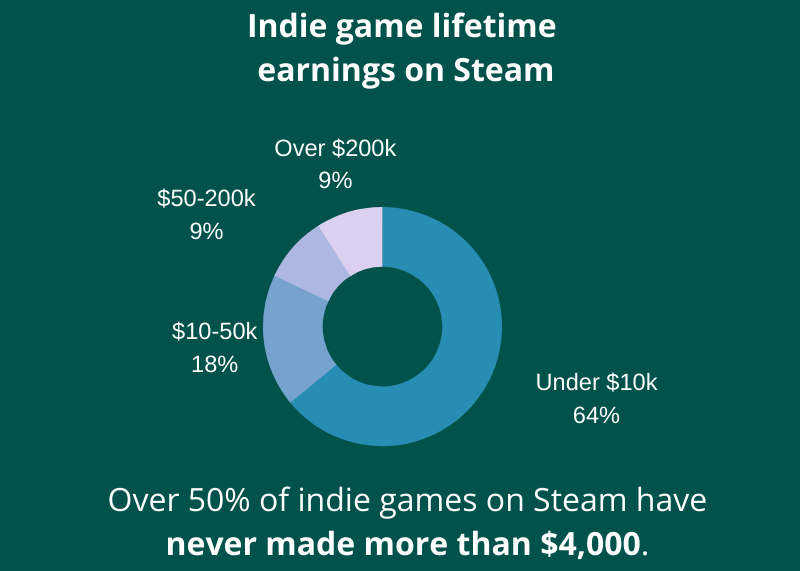
See Video Game Insights for the full infographic - and this is from 2020, it's only gotten worse.

There's also the opposite, a downward spiral where a game dies in obscurity. Aground is in the top 9% on the infographic above, meaning 91% of games never reach Aground's sales, let alone anything higher. Even though I know early access sales numbers are low, I am still worried after Stardander's launch, where we barely hit my lowest estimate. Can Stardander do the same thing as Aground with Early Access, or is it stuck in a downward spiral like the vast majority of games? Does Aground's path to success even work for story-heavy games or visual novels?


I don't have all the answers, and I'm worried even though I just said to have hope in this blog. But, that's a part of game development - you have to learn to manage your fears and try to give your game the best chance of success you can.

Tuesday, July 18, 2023

Making a Game from Start to Finish

One of the questions I’m asked a lot is what it takes to make a game. After more than a dozen years as a game developer, I’ve finished a lot of games (and I'm currently working on 2+).

This blog post covers my process of making a game from start to finish, along with thoughts and stumbling blocks along the way! Of course, this isn’t the only way to make games. But it’s the way that works for me!

The Idea

The idea stage is my favorite. Some people struggle to come up with new ideas, but personally I never have - ideas come to me faster than I know what to do with. Because of this, I try to at least keep my ideas organized. I keep all of my ideas in a spreadsheet, with a genre, score (how much I like the idea), description, and link to a game design document if it exists. I also keep notes, mainly things the idea is missing or needs to improve.

When I have a new idea, I add it to the sheet, or perhaps merge with and edit previous ideas. I also update the scores periodically to keep the best ideas at the top (there are currently 64 ideas in the list… the bottom ones will never see the light of day).

This also lets ideas age - when you have a new idea, it always feels special, like the best idea you've ever had. After a few months sitting in the ideas list, the novelty of some of the ideas wears off and it goes down the list, while some stay as interesting and exciting as ever.

When it's time to start a new game project, I have a list of ideas to look through that have had edits, improvements, and have weathered the test of time.

Finally, at the top of the list, I have a reminder for myself:

A good game idea
Is something I'm excited to make
Capable of making
And has a viable market

These may all seem pretty obvious, but it's surprising how many times I come up with an idea that doesn't follow one (or any) of them.

The Prototype

When I’ve settled on an idea, the first thing I do is make a prototype. The goal of the prototype is to see - vaguely - how the game plays and whether it is actually fun. I often share prototypes around with friends, and if there's something missing, I put a note in the ideas document and put that idea on hold until I come up with a potential improvement. While it's sad to put an idea on hold, it's always better to rethink things during the prototype phase - this is when you can change things with the least amount of work. Worst case, it's better to drop a prototype than a half-finished game. A poor idea almost never gets better with additional work and content.

Old prototypes that are dropped... for now...

The Honeymoon

I like to call early development on a game the honeymoon phase - that's because it's the most exciting part. The idea is still new, and a small amount of work can make huge improvements. Everything feels like it's going quickly and smoothly, and motivation is high. A short enough project can live entirely in this phase, although I rarely see that outside of game jams.

The Grind

Eventually, the honeymoon phase ends, and you need to start finding ways to motivate yourself to continue. New ideas beckon, and you see less and less progress for the work you put in. This is a normal part of the development process, and you have to learn how to stay focused and persevere, or you may never release a game. Keeping projects short reduces the grind, but even though I told myself I'd never make a 3+ year project again after Aground, I am currently working on two of them! The most exciting projects tend to take time, and they can be worthwhile, but you do have to find ways to deal with project fatigue.

Other than having self discipline (to motivate yourself and stay focused), there are two things that help me the most with project fatigue. One is to break tasks into meaningful and bite-sized pieces that I can check off and feel accomplished for finishing. The other is alternating between tasks I want to and don’t want to do throughout the project - if you always focus on the tasks you want to do first, you’ll end up with a large stretch of tasks you DON’T want to do. There are three things that cause the most grind for me - content, technical debt, and polish, which I’ll detail below.

Content

For me, the grind is often caused by content. The game is feature complete, the gameplay and aspects that are fun to code are complete and the game feels "done" in my mind, but it still needs a lot of content added. While it varies from project to project, I've found in general 1 hour of gameplay (for the player) takes about 1 month to develop. Without content, players won't know how to interact with all of the interesting mechanics you've added, and there won't be any cohesion to the game.

Mixing content and gameplay tasks makes a lot of sense - especially since new content usually unlocks new gameplay. However, if you're not doing a solo project, you often need to wait for art/content to be created by other team members, so sometimes I frontload all the gameplay tasks anyways. However, in this case, it can still be fun to see the new art and content made by others and integrate it into the game.

Technical Debt

Throughout a project, you will notice things that need to change or have feature suggestions or bug reports. Sometimes you fix these right away, but more often than not, you add it to a TODO list so you don't distract yourself from what you're currently working on. This is called Technical Debt - by putting it off, you have added tasks that you will have to complete later - and this can quickly get overwhelming.

Keep this list organized, be thoughtful before adding things to the list (does it REALLY need to be added), and clear items in it periodically to keep technical debt down.

Polish

There are two main kinds of polish:

  • Juice - Making the game more exciting and actions you take feel more impactful.
  • Oil - Removing stumbling blocks and making the game (and user experience) flow smoother.

You'll need both - as without oil, no matter how fun the game is, players will get frustrated and quit, and without juice, almost any gameplay loop will feel grindy. However, you can't just add "polish" as an item on your TODO list, it requires experimentation, feedback and iteration.

Here's a really good article about oil: https://www.gamedeveloper.com/design/oil-it-or-spoil-it-

Testing

Once you have something you're ready to share, I strongly recommend running a playtest and getting feedback from players - as you can never see your own game with fresh eyes. You'll rarely notice when your game is missing polish, as you're too used to the game and UI to notice a lack of oil, and you're too invested in the game to notice a lack of juice. However, during testing you'll get more feedback, suggestions, and bug reports than you know what to do with. If you're not careful, you could easily end up in an endless loop of technical debt and polish.

The Finish Line

At some point, you have to say the game is done. It will never be 100% - there will always be things you could do to improve the game. There's also a boost to motivation when you are near completion, so setting a firm launch date and choosing what final changes you want to make will often push you through the last bit needed before launch.

There will always be people wanting more (especially now that game as a service is a thing, and players are used to endless updates). So, find a place where you personally feel satisfied to call it done. You can always do a sequel or spinoff, if the right idea strikes you.

Conclusion

This blog post focused on the development side - as that is my forte. There's a whole list of marketing, publishing and post-launch stuff that's necessary too. Making a good game gives you the potential to succeed, but there's never any guarantee - even with a big marketing budget. But, I feel like just making it to the finish line of a large project is a huge achievement to be proud of. 

Thursday, September 8, 2022

Two games at the same time - crazy or genius?

As you might already be aware from my last blog post, we are currently developing two major games at the same time: Stardander School for Witches and Aground Zero.

There were many reasons for this decision - but the main one was that I wanted to do a follow-up to our previously successful game, Aground, but I also wanted to do something completely different (as I enjoy changing it up and experimenting with new genres). Additionally, our desire to make a witchy game predates Aground.


But, I'm a relatively fast programmer, and either project alone would leave me waiting for assets to finish and perhaps tinkering on a side project anyways. So I decided why not do both at once? With a 3D art team working on Aground Zero, and a 2D art team working on Stardander, and me switching between the two, I'd never have to wait for assets and could switch between projects to keep them both fresh and interesting. Often, long projects can start to feel dull and unexciting if you focus on just that one project for years at a time.


It's been about one year since this decision, and I thought I'd share my thoughts on how it's been going.

The Pros


In terms of efficiency, this has worked out as I expected. Overall it feels that I am accomplishing more and spending less time waiting for assets. While there have been delays to both projects, this is common in game development, and I don't believe that either game is delayed more than they would have been if I had focused on only one.


This plan could have gone poorly if either game was code-heavy (where the bottleneck was coding and not art/3D models) - but despite the fact that Aground Zero requires a lot more code than Stardander, I've been keeping up with both teams.

There was even a week where I felt ahead enough to tinker with a side project, although I've tried to refrain from that as two projects at the same time is already crazy enough. And, I haven't missed the side projects - as every time I switch projects, it feels like I'm coming into it fresh. There is a short transition time needed to change mindsets between projects, but this hasn't been problematic for me and I actually enjoy changing gears (as you can probably tell by my desire to make side projects in the first place).

Financially, while you have to pay two teams at once (and have the funds to do so), the total cost for each game is the same, and there will be less of a gap between game releases. While I can't say for certain how well either one will sell, that's certainly better than releasing the games years apart.

The Cons


The first thing I didn't even think about is the time needed for team management. While I consider myself mostly a programmer and game designer, I'm also the team leader and have to wear many hats - like checking in with both teams, approving assets and making sure everyone is on track. It should have been obvious - two teams means twice as much management!

I much prefer programming to management, so at first this came as a bit of a shock and I had to adjust to make sure both teams were moving smoothly. But, I feel like I've reached a good balance now, and I don't think this caused any long term delays.

However, speaking of other hats, there is one thing that HAS suffered: our ability to spend time on marketing and social media. If you've been on discord, you may have noticed a few sporadic update messages, but mostly I've been focused internally on making the games, and not making blog posts, sending newsletters, or anything else. It's gotten to the point where many people have asked if I'm still working on either game.

Additionally, even when I do share updates, our community is more fragmented. There are people who are more excited for Stardander, and people who are more excited for Aground Zero. I can't just focus on talking about one project, because there are two!

There's also work/life balance to consider. While I wanted to minimize down-time waiting for assets - sometimes that down-time is a good thing. It can allow you to take a break, be with your family, reset and maybe even work on a side project if it lets you relax and reset.

Finally, there's playtesting and polish. When you're focused on just one game, you end up spending a lot more time playing that game, noticing issues and tweaking it. Luckily, we have a private playtest for both games where community members have given me a lot of suggestions and feedback, but it's still more challenging to make sure both games get the time and attention they deserve.


Conclusion


While there were more cons than I expected when I first decided to make two games at once, I am still happy with the progress on both games. So my conclusion is mixed - I think it is working out, and I don't regret the decision, but I'm not sure I'd make the same decision again. I could probably work on multiple major projects at the same time more comfortably if I focused on being only a designer and manager, but I enjoy programming and I'd miss not personally coding the games.

Monday, October 18, 2021

The Future Fancy Fish Games

After the launch and final post-launch updates of Aground, we floundered (hah) for a bit deciding what to do next. We made many prototypes - several of which were put on hold, before finally settling on two games. Yes, that’s right, we’re working on two big games right now, and if that wasn’t wild enough, we also just finished a third game in a month-long game jam that you can play right now for free!

Stardander School for Witches

After finishing </reality>, the Visual Novel we made right before starting Aground, we had many ideas for better story-based games. But, at the time, we decided to hold off on them because of how challenging the visual novel market is. However, we both really like the magical school setting and kept trying to think of ways to make our witchy game idea better. We had loads of ideas before, during and after Aground’s development - from a tower-defense based game, to a multiplayer-only game. But, eventually we settled on a management/simulation style game where you can recruit, train, and battle with your witches - sort of like Fire Emblem: Three Houses.

This game is Stardander School for Witches, a narrative-heavy RPG rich in lore and worldbuilding, focusing on Dare (the fae cat you play as) and the witches she recruits. You can view the trailer for Stardander School for Witches below:

Stardander School for Witches will release Fall 2022, and you can wishlist it right now on Steam!

Aground Zero

We also wanted to do something directly related to Aground, but I always want to try something new, and making DLC for the base game just didn’t excite me. I wanted to change the art style, as a lot of people didn’t like the pixel art. The idea for Aground Zero came to me when I was reminiscing about one of our first commercial projects, I Can’t Escape: Darkness (ICED), which was a 3D game. I really liked a lot of the things I did for ICED, especially the lighting system (and I even had plans for a sequel), and I thought - why not make a 3D Aground spinoff? This idea was shortly before April, and prompted the April Fool’s joke of Aground: Minecraft Edition - a farcical but also partially true joke.


Aground Zero takes place during the events of the main game - but deep underground on Earth where you are one of the few survivors of the bombardment. You have to build up a bunker and rescue other survivors and eventually make your way to the surface. While it’ll have the mining and crafting of Aground, it’ll focus more on the base building aspects - taking the ideas from my scrapped colony update for Aground. You can view a short teaser for Aground Zero below:

You can wishlist Aground Zero on Steam now:

Stardander Revenant

As if making two games at the same time wasn’t enough, when the Spooktober visual novel jam came around, we couldn’t resist making a halloween-themed spinoff of Stardander. The core mechanics are the same as Stardander School for Witches, but the story, characters and enemies were all made in the month of September for the jam.

Stardander Revenant is short (1-2 hours) and story-focused, but I definitely like the interactions between the two main characters (fun fact: they are based on our cats). You’ll also have some interesting battles (especially on hard mode) that require you to utilize the spells that your two older witches have learned (and you get to teach them some more spells along the way). You can view the trailer for Stardander Revenant below:

And you can play Stardander Revenant now, for free, in your browser or as a downloadable!

Wrapping Up

That’s a lot of announcements to go through, and it looks like 2022 is going to be a busy year for us at Fancy Fish Games! Which game are you most excited for? Did you give Stardander Revenant a try?

And, after having made many prototypes, I have plenty of ideas for what to make next! My game ideas document continues to grow (now at 61 entries), so Stardander and Aground Zero are only the beginning! Look forward to a lot more from Fancy Fish Games!

Sunday, January 10, 2021

Year in Review: 2020

It's hard to believe that my last real Year in Review was for 2016. I haven't been keeping up with this blog as much as I'd like, but this time it's been because of how busy we were with Aground between 2017 and 2020.

Aground

In April 2020, we finally released the full version of Aground, and over the summer we released our final major content update - the Hybrid Path. As difficult as 2020 was for everyone in the world - us included - Aground's launch was by far the biggest success we've ever had. We are so proud of how far the game and its community has come. Achieving an "overwhelmingly positive" review score was one of my long-standing goals as a game developer, and even though it is just a number, it was really special when we finally reached it.


The console ports for Aground are nearly ready to launch - so look forward to that early this year on the PS4, Switch and XBox One. Beyond that, while we've considered expansions/sequels/DLC for Aground, we kind of feel like it is done, and has a strong, complete story, and we are ready for something new. We may come back to Aground at some point, but it will not be our next project.


The big question is: what comes next?

Prototypes


So, what DOES come next for Fancy Fish Games? When in doubt, I do what I've done in the past (and what actually gave rise to Aground) - rapid prototypes to find out what works, and what to focus on. We now have several prototypes, and while we aren't fully decided, it's likely we'll be working on Stardander School for Witches (previously called Witch Academy) next. Which is funny, as in my 2016 year in review, one of our goals was to push this project forward after </reality>.


Ideas have been circulating for this game for a long while, and Natalie has already done a lot of art for it (as you can see above), but only recently have we put together a strong prototype for it. I'm also very proud of the battle system, which is one thing I've struggled with in other game designs.

Monday, February 3, 2020

The Contradictions of Game Development in 2020


"It's the easiest time to get into game development." VS "It's the hardest time to get into game development."


It has never been easier to make and self publish a game. There are many powerful engines to choose from, and you can put your game on major online stores like Steam at the click of a button - without needing to convince anyone your game is worthwhile or get through Greenlight. While people still struggle to finish and release a game, that is usually due to lack of time, motivation, and perfectionism (internal struggles), not external hurdles that you need to overcome.

Probably everyone has seen this graph by now...

At the same time, because of this there is a flood of games - over 8k games were released in 2019 on Steam alone! It's easy to say these are mostly low quality games or asset flips and that the "good" games still do well, but far too many of the games that fail were works of passion that simply weren't well tested, polished, didn't find their audience or simply disappeared in the flood of games. The problem is, when so many games are being released every day, people don't even have time to look at them all - they have to assume every game is trash until proven otherwise. Yes - this means even if you spent years making the perfect game and finally released it, the vast majority of people - even those who might love the game if they played it, will skim right past it and not give it a try.

In 2020, the base assumption is that your game is crap - and you need to convince the world otherwise! But how?
This is why you'll hear so many people complaining about marketing or asking how to do marketing. No one believes their game is trash, and everyone is trying to get people to even consider their game.

"A great game will market itself." VS "You need a focused marketing plan in action 2+ months before launch."


Nowadays, word of mouth is everything - with social media, streamers, etc, it's easy for people to spread the word about great games. That is the reason for the argument that a remarkable game will sell itself - people will love it, share it, and momentum will continue to grow even if the launch was lackluster.

One popular you-tube video can easily build momentum months after launch.

On the other hand, many will argue that a game NEEDS at least a few months of a focused marketing campaign before launch - that even the best game will get swept up in the never-ending stream of new game releases without any marketing.

The issue here is that while it is true that word about a remarkable game will spread - this is only true if people know about the game in the first place. If too few players give it a try - their circles of influence will only extend so far. You NEED a remarkable game - something that will get players to talk about it - but you also need players. It doesn't have to be a traditional marketing campaign, but you need a way to build a community and get a large enough seed of players for talk about the game to grow.

I had a lot of success sharing a free web version of my latest game, Aground - over 3 million people played it, and while only a tiny fraction of that bought the game, enough people enjoyed it and joined the discord or talked about it that Aground continues to sell well to this day - over a year since the early access release.

"You need to accept feedback to make a good game." VS "You need a strong vision of your game and stop adding unnecessary features."


Once you've made a few games, you'll come to realize that you're a terrible judge of your own work. You may love it when others hate it, or hate it when others love it - either way, you'll need some unbiased feedback if you want to get a good idea of how the game actually plays to tweak and polish it.

Unfortunately, people suggest what they know, and their feedback will often skew your game to becoming less unique and further from your vision (and, therefore, less remarkable). Additionally, for some reason, people LOVE suggesting new features and can quickly overwhelm you with feature bloat if you accept them all.

My latest game, Aground, has multiple suggestions threads on our subreddit with more feature suggestions than I know what to do with (and I accepted way too many)... 

The key here is that you NEED feedback, but you can't just take every suggestion at face value. You have to try to understand why they suggested it - what were they thinking and feeling? Why do people keep suggesting new features? Could it be because there's not enough to do in the game, or that the main gameplay loop feels repetitive and needs something to break it up? Do they want you to add a traditional health bar just because it's what they're used to, or are they unable to understand your way of managing health - perhaps because of a lack of tutorials?

Playtesters are vital, and are very good at detecting problems... they just tend to be poor at explaining what the problem actually is. And while sometimes their suggestions are great, sometimes they are ineffective as they are trying to solve a deeper problem with the game by just slapping on a new feature.

"People buy what they know they will like." VS "Make something unique and remarkable to stand out of the crowd."


One of the easiest ways to get players to consider your game is to be similar to past games they enjoy. If someone likes Pokemon, and you have a game that appears to be a Pokemon clone, they are likely to check it out. There was a whole study about this which you can read here: https://www.gamasutra.com/blogs/ChrisZukowski/20190906/350248/How_Steam_users_see_your_game.php

One of the store page evaluations in the above study. It looked like something they would enjoy - in fact it was in a series they had played before - and the tags matched their preferences.

On the other hand, you need something remarkable that will spread via word of mouth if you want to be successful. Is a clone remarkable? Maybe within a community that likes that game, wants more and there isn't a surplus of clones for. But it's certainly not unique or something that will spread beyond that community, and the more similar games that appear - games that might have better art or push the boundaries of that style of game more - the less appealing your game will be relatively.

This is probably where "know your audience" becomes the most important - make something remarkable and unique so that it will continue to spread and grow, but also figure out how to appeal to the audience that will enjoy that unique experience. What genres do they like? How about art styles? Your game must both BE something they enjoy and APPEAR to be something they will enjoy (even at a very cursory level) so that they will try your game and have a desire to talk about your game when they finish it.

"Making games isn't all fun and games." VS "Have fun when making games, and your passion will shine through."


This last one is more of a joke - but there is truth to it. Even now, when making and publishing games is easier than ever - it is still hard. I haven't heard of a single game launch where everything went smoothly - it always takes longer than you expect, and there are always rough patches before you get to the end, and bugs and crises when you do. But, if you aren't enjoying making games, then why are you even making them? Beyond the fact that you might be making bland, soulless things you just hope will sell - you'd probably have a much easier and more successful shot making... almost anything else.

So have fun. Make games. Play games. Navigate the seemingly impossible contradictions of gamedev to struggle your way to success. Or don't - definitely give up and do something easier if you find you're no longer passionate about gamedev and are falling into debt. Here's one last contradiction to mull over:

"Never give up - keep on trying until you succeed!" VS "Fail faster - give up as soon as you realize it will be a failure, learn what you can, and move on."

Monday, July 22, 2019

What the Indiepocalypse Means for Gamers

As an indie dev, the "indiepocalypse" is a topic that always interests and frightens me. There have been tons of articles about the indiepocalypse since around 2015 when Steam started to open the gates of greenlight and a ton of new games were let through onto the store, but very few have touched on how the indiepocalypse is shaped by and affects gamers. My goal with this article is to bring the indiepocalypse into a broader perspective.

What is the Indiepocalypse?

Obviously, it's been 4+ years and indies (myself included) are still around, so the indiepocalypse is not the mass extinction that some people feared. However, things have changed - it's much harder to gain attention for all indies, and some genres have begun to die out. As many earlier articles pointed out, this is a natural market process - supply and demand. As supply of games go up, and demand remains the same, competition increases, prices drop, and some studios fail. As indies struggle to survive, they figure out which genres/styles of games do well, and which don't, and stop making the games that are doing poorly (except for the studios that don't care about money or whether they operate at a loss or not).

This GDC talk: https://www.gdcvault.com/browse/gdc-19/play/1025672 was pretty eye opening for me. As an "older" game developer and gamer (I'm 32), my favorite kinds of games are really powerful, impactful and short, as I don't have a lot of time in my life to play games. I want as much bang for my buck in as few hours as possible. But this is exactly one of the kinds of games that is dying out. The "infinite" games that can keep you coming back for hundreds of hours and always have thousands of concurrent players are the ones that are thriving (and it makes sense - streamers will play your game longer and have a higher chance of being seen, and people tend to recommend games they are currently playing, not games they played in the past). It should be no surprise that never-ending updates and games as a service are major trends in the game development industry.

So, the indiepocalypse is really more of an industry wide change than death, and change isn't always a bad thing. However, I'm a little concerned about HOW games are changing.

Longer = Better?

Because it is short, it's only worth $5 to this reviewer, no more.
With prices constantly dropping, and game duration constantly increasing (as "infinite" games are the ones that are thriving), the idea of dollars per hour of gameplay has continued to strengthen. I've seen many beautiful games that I enjoyed get negative reviews simply because they were "too short", or "too short for the money". So, games that want to survive need to get longer without costing more to make. There are many ways to do this:
  • Adding multiplayer so players can entertain themselves.
  • Endless tasks/goals that the player can grind until they are satisfied.
  • Sandbox style gameplay where the players can continually come up with their own goals.
Games that focus on stories or hand-crafted content tend to fail - as they are either too short, or cost too much per hour of gameplay, and I feel this is a shame.


My latest game, Aground, is kind of a mix of hand-crafted content and story alongside optional sandbox and endless gameplay - so players who want an infinite game can easily play hundreds of hours and enjoy things slowly unlocking, and players who want a faster paced game like me can rush through and enjoy all the new content and story. While Aground has been doing well (partially because of the potential sandbox gameplay, and partially because of the regular updates while we are still in Early Access), it takes a considerable amount of work to add a small segment of gameplay. While it varies by play-style, it takes approximately one month with 3 developers working full time to create one hour of play time. With the perceived value per hour of games dropping all the time, it becomes harder and harder to justify that amount of effort for such a small amount of play time.

Vote with your Wallet

Obviously, I am biased and like story-based hand-crafted games. That doesn't mean that they shouldn't die out (or that they won't re-emerge eventually like what happened with point & click adventures) - but the decision lies with you. It's like an election, except the only way to vote is with your wallet. When you decide to buy a game, that affects the market. When you decide to purchase micro-transactions or DLC, that affects the market. When you scoff at a $100 game as too expensive (even though game prices should be increasing with inflation), that affects the market. When you pirate a game, that affects the market too.


I hear a lot of gamers complaining about Free to Play games (and I don't like them either), but when it comes down to it, people put a lot of money into those games, and don't buy up-front cost games (because they are too expensive), or worse, pirate them. Even the scummiest F2P developer is just trying to survive in a tough market, and is creating what people will pay for.

What games are available, and what studios die, are indirectly determined by where you decide to throw your support.

TL;DR

In short, there is no indiepocalypse if you define it as the death of all indies. There are just developers struggling to survive, some evolving, more dying out (as the market cannot support as many developers as there are). And more often then not, the developers who die out are the weird and quirky indies who make what they believe in regardless of whether there's a market or publisher for it. These changes are driven mostly by gamers - what they are willing and unwilling to spend money on. If you want developers or genres to survive, support them. If you're unhappy with how the market is evolving, change where you spend your money.

Just remember, what a digital game is worth may be what gamers are willing to spend on it, but what it costs to develop is separate and constantly increasing. If the cost outweighs the value (as perceived by gamers), people will stop making that style of game.